Welcome to our Cold Agglutinin Disease (CAD) family!
We have been where you are. Please know that this website was created as a non-profit endeavor by and for CAD patients and their families and caregivers. We are dedicated to providing you with the basic tools, resources, and support for your own personal journey in learning about CAD and how to live with this rare disease.
CAD is a chronic condition that must be managed in partnership with your physician. Symptoms can vary in duration and severity, and while they can be treated, there is currently no known cure. Promising CAD clinical trials are underway, and some participants have shared their experiences in our private Facebook group, CADdy CHATTER https://www.facebook.com/groups/192296905079/. Enjaymo is currently the only FDA-approved treatment for CAD. Rituxan is an off-label option you may wish to discuss with your doctor, and some physicians may use other off-label treatments. Although a few physicians may still recommend steroids or splenectomy, these are older approaches whose effectiveness for CAD have been discredited (Röth et al., 2022; Despotovic & Kim, 2022).
It can be difficult, confusing, and overwhelming to deal with a diagnosis of a rare disease such as CAD. Statistically, we are a small percentage of all autoimmune hemolytic anemias. As a result, CAD is often overlooked, misdiagnosed, or confused with other diseases. There is one new case of Cold Agglutinin Disease per million per year (Airdi, 2026). Many healthcare providers, including hematologists, will never diagnose or treat a CAD patient during their entire career. Adding to the challenge is the unfortunate reality that hospital and commercial laboratories are often unfamiliar with the specialized blood collection and handling protocols required to ensure accurate blood test results for CAD patients (MLabs, n.d.; Medscape, 2025). Knowledge is power! The Cold Agglutinin Disease website https://coldagglutinindisease.org/ will enable you to learn about CAD. The CAD Foundation encourages you to investigate our website where you will find valuable links and up-to-date information to explain symptoms, diagnosis, treatments, coping skills, advocacy, and support. What happens with CAD Normally, antibodies bind to foreign bacteria and viruses to fight our illnesses, but in our case, we have autoantibodies which are antibodies that mistakenly target and destroy our red blood cells. This occurs at temperatures below body temperature or during illnesses, particularly those with a fever. However, sickness without fever, surgeries, and injuries may increase CAD patients hemolysis and lower hemoglobin levels. CAD activates a part of the immune system called the classical complement pathway which causes inflammation in the body and increases fatigue (Berentsen, 2025; Despotovic & Kim, 2022)
What happens with CAD
Normally, antibodies bind to foreign bacteria and viruses to fight our illnesses, but in our case, we have autoantibodies which are antibodies that mistakenly target and destroy our red blood cells. This occurs at temperatures below body temperature or during illnesses, particularly those with a fever. However, sickness without fever, surgeries, and injuries may increase CAD patients hemolysis and lower hemoglobin levels. CAD activates a part of the immune system called the classical complement pathway which causes inflammation in the body and increases fatigue (Berentsen, 2025; Despotovic & Kim, 2022).
Choose a specialist to become part of your medical team
If you have been diagnosed with CAD by a family doctor or internist, it is advisable to find a hematologist/oncologist who specializes in treating rare blood disorders (and preferably one who is board certified in that specialty). Ideally, they will have some familiarity with CAD. It is always appropriate to ask how many patients they have treated with CAD. Our CAD Community has a Specialist Page where you can find Hematologists at https://coldagglutinindisease.org/specialists. Here you will find a map and physician/specialists’ directory, including information which has been provided and shared by fellow CAD Patients.
Diagnosis
Your experience to confirm a diagnosis of CAD will begin with a Coombs/DAT test, which is done to find IgM antibodies that attack red blood cells. Your doctor will use this information as well as the results from other blood tests to determine if you have CAD. Your physician may also order other testing such as a Bone Marrow Biopsy (BMB) and CT scans to determine if your CAD is primary (unknown cause) or secondary, caused by infections (viral and bacterial), lymphoproliferative disorders, or other autoimmune diseases (Berentsen, 2025; Medscape, 2025).
Blood Testing & Physician Visits
Once you have been diagnosed with CAD, your physician will probably begin with a course of blood tests, which most doctors recommend to monitor your condition. The severity of your condition will determine how frequently your blood is tested. You will want to become familiar with the specific tests used in lab reports which are of particular concern to CAD patients. Some of the most important tests include hemoglobin, (HGB), lactate dehydrogenase (LDH), reticulocyte panels and bilirubin. A Complete Blood Count (CBC) and a Comprehensive Metabolic Panel (CMP) are different blood tests that measure your hemoglobin, various liver enzymes, and many other blood-related properties.
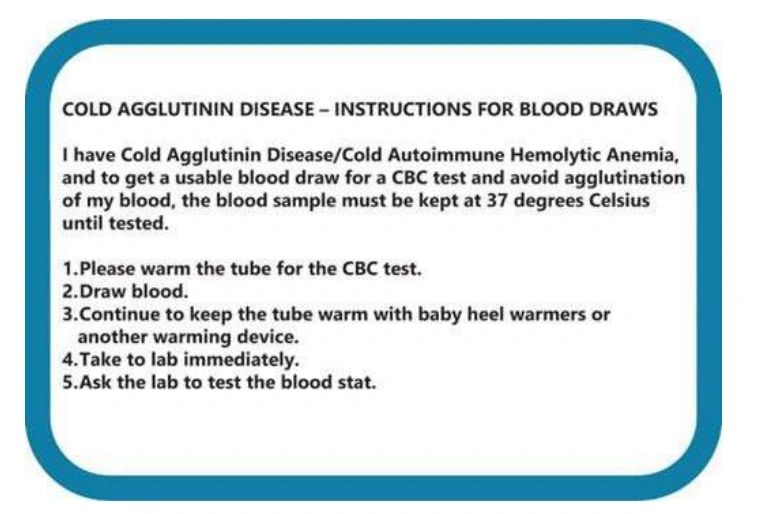
It is crucial that the test tubes for collecting blood for your CBC tests be warmed prior to blood collection (typically with baby heal warmers or a medical warming container) and that the blood sample be kept at 37 degrees Celsius until tested – it should be tested immediately (stat). If the test tubes are not warmed and/or the blood sample is refrigerated or is allowed to drop below body temperature, it will not be usable. Rewarming the blood will not produce accurate results. Accurate blood tests are essential for correct treatment. You can check your blood test results to see if it was done properly by taking your RBC result X 3 which should closely equal your HGB. Your HGB X 3 should closely equal your HCT. This is called the Rule of Threes (MLabs, n.d.; Medscape, 2025).
Your hospital, medical system, or doctor should make the results of your tests available to you. If you do not understand the more complex medical terms used to explain CAD and its treatment, do not hesitate to ask your provider or someone with an appropriate medical background to explain them. Most hematologists will have patients take Folic Acid (Also known as vitamin B9) and possibly B12. Folic Acid and B12 are crucial for red blood cell production. The amounts are different depending upon the country you live in as some countries fortify a number of foods with Folic Acid and others do not. B12 is also important for red blood cell production, and your levels should be checked to make sure they are adequate.
Particularly just after diagnosis or when considering treatment, it is helpful to develop a list of questions and concerns in writing to discuss with your doctor. Having a responsible person or caregiver accompany you to doctor appointments to help you remember and write down all the new information you need to absorb can be invaluable.
Cold Avoidance & Symptoms
Cold Avoidance is crucial in managing this disease. Each of us reacts at different ambient temperatures (the temperature of the environment you are in) and it may take time to determine what temperature range that is for you. Cold causes agglutination, where red blood cells stick to the agglutinins, and then our red blood cells are tagged for destruction. Destruction of our red blood cells happens quickly with cold exposure, viruses, and infections, even with infections that cause fevers. NEVER use ice. Ice will quickly initiate agglutination and hemolysis. It can be helpful to wear gloves when pulling items out of the freezer or refrigerator. You can also run your hands under warm water when working with cold food items. Painful purplish fingers, nose, ears, and toes are a sign of acrocyanosis and means agglutination is occurring, and the temperature is too cold. These areas of our body are affected first and need to be covered when we are in cool/cold temperatures. Cold-induced blue or purple discoloration of the extremities caused by CAD is not the same as Raynaud’s. While some individuals with CAD may also have Raynaud’s, the underlying mechanisms differ. Breathing cold air is also a problem that many do not realize. Always dress warmly in layers. There are many items such as handwarmers, toe warmers, and heated rechargeable devices that are extremely helpful to us (Berentsen, 2025; Despotovic & Kim, 2022).
Air conditioning can be just as dangerous as winter temperatures! Bring layers when working, shopping or eating in air-conditioned rooms. We must always be prepared!
Please note that you can often be experiencing hemolysis without realizing it at the time. You typically will encounter symptoms a few hours or possibly a day or two later. These symptoms may include fatigue, brain fog, and/or tea colored urine, as well as others. CAD symptoms vary among patients, though everybody with a CAD diagnosis has great sensitivity to cold or cool temperatures.
Receiving treatment is dependent upon the severity of your symptoms and how they affect your quality of life. Blood transfusions may be necessary if you experience a severe drop in hemoglobin. It is crucial that transfused blood, saline drips, and other fluids be warmed before being administered to avoid agglutination in your body. If the infusion cannot be heated, it should be brought to room temperature (Koyama et al., 2021; Yamaguchi et al., 2022).
Print out and carry essential information (see following pages)
- A handout for Medical Professionals for the times you aren’t able to describe this disease and/or need to communicate the basic important concerns about CAD to providers, caregivers and others (Page 5).
- A downloadable PDF card printout of special instructions to give to your lab test technicians for collecting and handling your blood specimens (Page 6).
A Med Alert bracelet is advisable.
The bracelet should include information such as: Cold Agglutinin Disease, NO ICE, KEEP ME WARM, WARM BLOOD TRANSFUSIONS and IV FLUIDS. Many emergency medical professionals have never heard of CAD. This is critical information which could save your life. Several options are available, from simply an engraved bracelet to a bracelet that also connects to more detailed information you provide that can be securely accessed by EMT’s and medical personnel.
How do I explain this “invisible” disease to family and friends?
CAD is a rare disease and as such, quite different from more obvious physical disabilities or common illnesses that most people are familiar with such as heart disease, cancer, or diabetes. Even those CAD patients who are afflicted to the point that they are deemed to be legally disabled for work or who suffer from extreme fatigue might not appear visibly disabled to an onlooker. It can be awkward, if not embarrassing, to explain why we must avoid cold drafts, foods and beverages, and why some of us need to wear heavy sweaters, hats and gloves, even in temperate climates, not to mention explaining why our bodies, especially our noses, toes and fingers turn blue or purple in temperatures which others find perfectly comfortable.
Many of us with CAD have learned to provide a quick description for our complex condition: For example, we might say we have an autoimmune disease that makes us “allergic” to the cold, “Cold temperatures kill my red blood cells, so I need to keep warm,” or we might explain that cold weather causes our anemia and fatigue, which can’t be cured by taking iron supplements (anemia caused by iron deficiency is something totally different). Cold-related blue and purple extremities caused by CAD are not Raynaud’s but are just as painful.
To those who live with or care for us, we should also add that we must closely monitor any symptoms that might suggest blood clots or strokes, for which we are considered at higher risk. Family members and caregivers need to learn about CAD in case we require medical attention of any kind (Broome et al., 2020).
Living with CAD
Simply put, CAD does not affect each of us in the same way. Some CAD patients have only moderate symptoms; some will find the disease changing in severity as we age, and others must take a more aggressive and proactive approach to their symptoms from the very onset. Statistics show that most of us are mature adults when diagnosed, often coping with other age-related health issues that have no connection to CAD. There are younger CAD patients who may face different personal lifestyle challenges than their seniors.
Remember, you are not alone. Our CAD community is accepting, warm, and supportive. It is most likely that you do not personally know anyone else with CAD or any autoimmune hemolytic anemia, and it can be isolating, so we are here for one another. We help each other with support and information on our CAD journey together.
Welcome!
Knowledge is power!
The Cold Agglutinin Disease website https://coldagglutinindisease.org/ will enable you to learn about CAD. The CAD Foundation encourages you to investigate our website where you will find valuable links and up-to-date information to explain symptoms, diagnosis, treatments, coping skills, advocacy, and support.
TAKE THIS CARD TO YOUR LAB OR HEALTH CARE PROFESSIONAL